
There has been little integration so far between biodiversity policies and bioeconomy strategies. For the most part, these end up being two distinct fields, with little conversation between them. That is something that needs to be addressed.
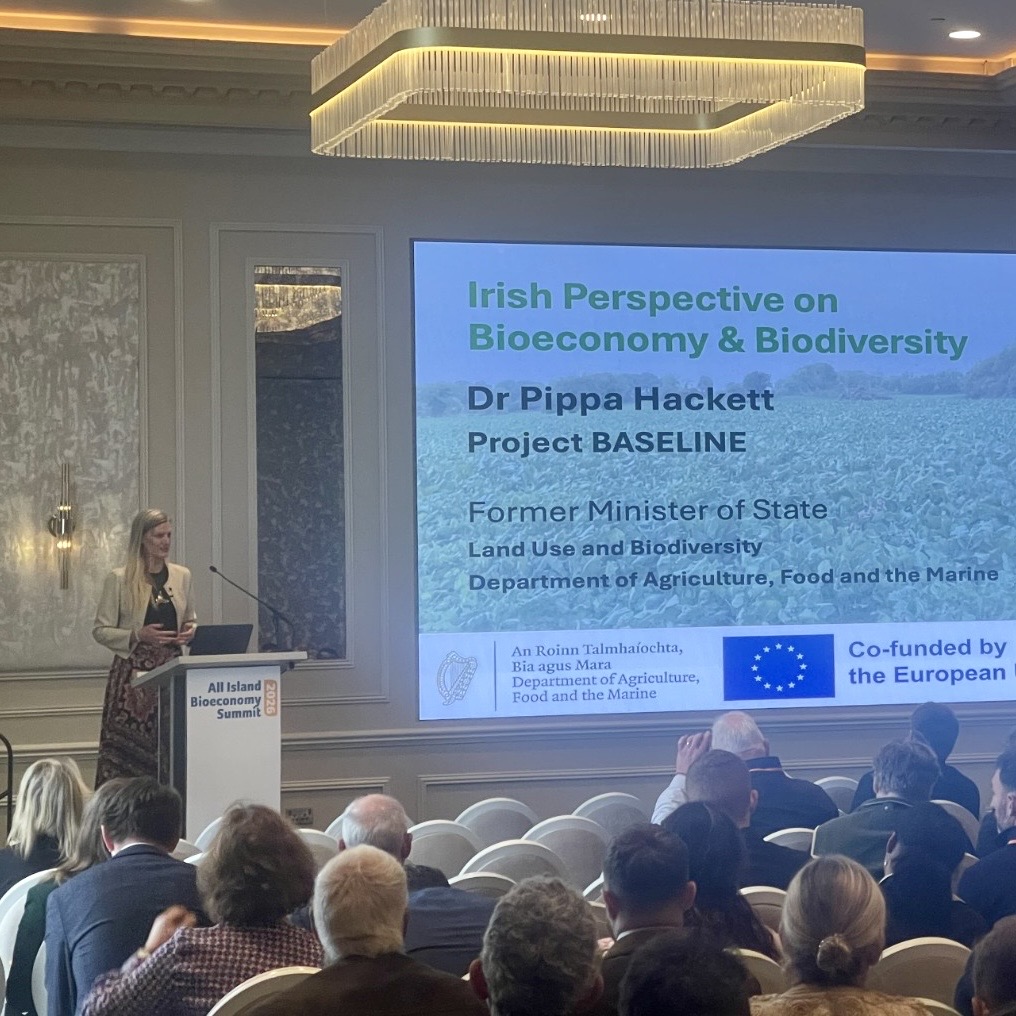
Speech from the All Ireland Bioeconomy Summit, May 19th 2026 (www.bioeconomy.ie)
When I was first presented with this topic for today’s summit, I was initially quite challenged, about the link between the Bioeconomy and Biodiversity, because it’s not something that is discussed very often.
But I was intrigued too about what it could mean for the Bioeconomy sector itself, and what it might mean for primary producers – who, at the end of the day, are largely responsible for producing much of the raw material which drives the bioeconomy.
Bioeconomy
Bioeconomy is a word you are all very acquainted with, but it’s still very much an unknown concept to many people in our communities.
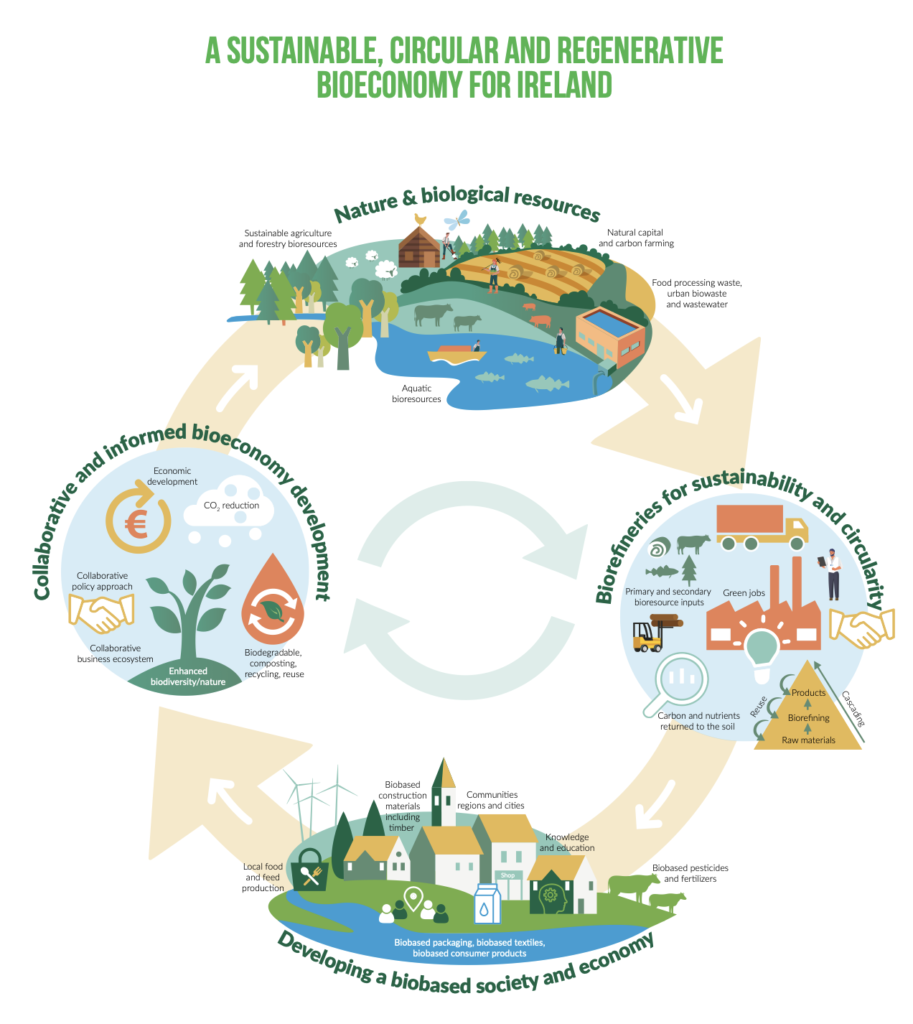
This diagram is from Ireland’s Bioeconomy Action Plan (2023-2025) – and it’s great to see that word ‘Regenerative’ there – I’ll come back to that later.
We humans, of course, have been working in the Bioeconomy for millennia, making the best use of reusable biological resources from land and sea – growing our own food, composting, using timber for construction and heat, and using wool, leather and other fibres for our clothes and textiles.
What is new and exciting now though, is the research and innovation within the bioeconomy which can help us scale up our use of renewable resources, to combat the challenges of climate change, and associated problems like food security, and environmental pollution.
As we all know, we have been too heavily reliant on fossils fuel-based products like plastics and synthetic fertilisers, and as we all know we need to urgently find alternatives.
Innovation in the bioeconomy is identifying those alternatives, and the change is happening right now across this island, as you will hear about today.
But as long as we continue to rely on nature to provide the raw materials for our future economies, then the ‘bio’ in bioeconomy must ensure this is done with biodiversity to the fore, otherwise we run the risk of replacing the traditional extractive economy with a greenwashed equivalent.
Biodiversity
The term Biodiversity is now commonly used and widely understood. The Irish Government even declared a ‘National Climate and Biodiversity Emergency’ seven years ago in 2019. But biodiversity means different things to different people – for some it means the return of a threatened species of bird, for others it relates to rewilding, pollinators, or no-mow May.
For me Biodiversity starts in farmland soil.
Two-thirds of the land area of Ireland is agricultural – so how we farm and manage our land has probably the single greatest impact on the biodiversity in our country.
If we can’t restore nature through agriculture, then we are on a slippery slope of continued decline, exploitation and pollution of our natural resources.
And simply sticking the prefix “bio” in front of a word doesn’t by default make it better!
And if we are honest, the nexus of Biodiversity and the Bioeconomy, has not received much attention from policymakers, or perhaps even from the bioeconomy sector itself.
The dominant policy approach often assumes that the bioeconomy is inherently sustainable.
But is it?
And what is needed to ensure that it is?
Well, a strong and earnest will from the Bioeconomy sector now, to protect and enhance nature and biodiversity through its business model, without waiting for regulations to enforce it.
For example, under the EU’s Corporate Sustainability Reporting Directive, large companies are now responsible for reporting their GHG emissions across their business operations, including their value chain emissions (known as Scope 3). And more recently these companies have been mandated to report on their contributions to mitigating biodiversity loss too.
By rights, the Bioeconomy sector should be ahead of the curve on this, but research has shown that most bioeconomy strategies have paid little attention to trade-offs and goal conflicts.
For example, any risks to biodiversity, say through the production of biomass or biofuels based on monocultures or unsustainable farm practices, may not be taken into account in these strategies.
Therefore, it is crucial to think about ways to advance the integration between the bioeconomy and biodiversity.
Questions for Bioeconomy Businesses
Simple questions for anyone working in the Bioeconomy today are:
“Has the production of the raw material for your bioeconomy business had a positive or negative effect on biodiversity?”
or
“Does your bioeconomy business protect a natural resource?”
If you do not know the answers to questions like these – then perhaps it’s time to find out!
Because, if the bioeconomy is to be truly bio and circular, then it must drive green growth and nature friendly, regenerative production models, to create those much-needed sustainable products to replace fossil-based materials.
Farmer focus
Most supply chains begin with a primary producer – usually a farmer, a forester or a grower.
From a farming perspective and from a biodiversity perspective, there are many examples we can lean on in relation to the transition agriculture can and must make to become more resilient and more sustainable.
More resilient to shocks – both economic and climatic; and more sustainable in terms of protecting and enhancing nature and habitats, water quality, and reducing GHG emissions.
And here I feel I can speak with some conviction, not only as a former Policy Maker, but as a Farmer, and as a project manager of a European Innovation Partnership project on Regenerative Agriculture called Project BASELINE (see www.projectbaseline.ie)
Project BASELINE is all about working with farmers and growers who have already adopted regenerative principles and practices on their farms, and are seeing the benefits on their farm biodiversity, and in their farm finances. It’s so important to keep that focus on the farmer.
And it’s clear that if Ireland is to meet its climate and nature related targets, then a new baseline is needed for Irish agriculture. Because unfortunately, we continue to see degradation in our habitats, soil and water quality.
The solution may not need much in the way of new technology, but it does need new thinking, and further incentives and advice to support farmers to reduce their reliance on environmentally damaging chemicals, and to work with nature (and the soil) to improve farm incomes, produce higher quality food, improve water quality and biodiversity, and lower GHG emissions.
And of course, produce a better raw material for the Bioeconomy sector!
A significant problem we all face is how to address the damage already done to biodiversity by agricultural intensification; and any bioeconomy-based approach which works with the agri-food sector has a responsibility in this regard also.
This is no longer about mitigation or merely reducing future impact – this is about regeneration and reversing the damage.
Regenerative
And this is why I was so pleased to see that term “Regenerative” used in the diagram earlier.
These days, we are hearing more and more about regenerative agriculture, about biological farming, agroecology, and organic farming.
These are not just buzzwords…because behind them are open-minded and future thinking farmers, and they are all potentially the antidotes to the current extractive agricultural model we’ve been following, and something the bioeconomy sector should be championing.
All of this comes with a caveat however, because if we are to truly live within our planetary boundaries, we cannot simply replace petrochemical production with bioeconomy production, and carry on business as normal, with the same consumption models and economic expectations.
Perhaps it is also time to reconsider the metrics for judging our success. But that is probably the topic of another discussion, but an important one, nonetheless.
In October 2023, I gave a keynote address at the UN’s World Food Forum in Rome. The theme for that Forum focussed on the Bioeconomy being the catalyst for agrifood systems transformation.
The Bioeconomy, however, needs to be more than just a waste economy – it needs to proactively drive regeneration of our natural resources, habitats and wildlife.
Quite simply, the Bioeconomy needs to succeed where the traditional economy has failed.
And likewise Regenerative Agriculture needs to succeed where ‘conventional’ agriculture has failed.
How do we do this?
We do this by applying conservation, agroecological, biological and organic practices to mainstream agriculture.
There is massive empowerment in enabling farmers to make their own decisions on their own farms.
For decades many of those decisions have been dominated by conventional advice which has driven production over profit. This has come at a cost to farm families across the country, and also to our precious natural resources.
But change is happening – only last week for example, I was at UCD’s Lyons Estate with regenerative farmers from BASE Ireland to see the work of Profs Tommy Boland and Helen Sheridan on multi-species swards. And it was great to see that this work is being supported and funded by BiOrbic, among others.
For anyone who doesn’t know, multi-species swards are the remedy to monoculture grasslands, and are fast becoming a resilient way to grow forage for livestock. We’ve been growing them on our own farm for nearly 10 years, and they have served us really well. Not only do multi-species yield healthier, faster growing animals, they are resilient to extremes of weather, and support biodiversity (above and below ground) with their various flower and seed heads and mixed length roots.
The benefit of Regenerative Agriculture in all its guises is something the Project BASELINEEIP is trying to measure and highlight, ultimately to support more farmers in making informed decisions about what regenerative practices to implement on their farms.
Where to now?
Only last year, the European Commission published a new Bioeconomy Strategy – which as expected is all about replacing fossil-based resources with sustainable biological ones for a circular, climate-neutral economy.
The Bioeconomy, it says, has the potential to advance the EU’s environmental goals and develop a circular economy, without damaging nature.
Generally, however, there has been little integration so far between biodiversity policies and bioeconomy strategies. For the most part, these end up being two distinct fields, with little conversation between them. That is something that needs to be addressed.
What can we do in an Irish context?
Perhaps this Bioeconomy Forum could work towards showcasing Irish bioeconomy practices and successful case studies that support biodiversity conservation and ecosystem restoration?
Or, maybe it could highlight Irish examples that account for the trade-offs involved in the development of a bioeconomy?
There is also a need to raise general awareness on the role the bioeconomy can play in supporting biodiversity.
Effective solutions must engage producers and consumers, and everyone in between.
I hope we are all agreed that Biodiversity is both vital for healthy ecosystems and the foundation of our own well-being and economy. However, it is under severe threat, and a well-functioning circular bioeconomy will be key to its restoration.
What Next for the Bioeconomy?
Finally, I will leave you with some pertinent points from the European Environment Agency…
It is essential that we transform our current production and consumption systems to reduce pressure on biodiversity. EEA research indicates that the food, construction, energy and textile sectors account for approximately 90% of the pressure on biodiversity worldwide.
So, what should we do?
- Firstly, more efficient resource use: this reduces the demand for primary resources which in turn lowers pressure on biodiversity.
- Secondly, preventing pollution: this can be done by minimising waste, and by minimising the use of hazardous substances (substances which are tricky to reuse or recycle, and substances that damage natural environments and human health).
- Thirdly, biodiversity-friendly sourcing: this involves avoiding harming natural systems and promoting regenerative practices.
- Finally, integrating biodiversity metrics into investments and policies, puts biodiversity at the core of any decision making.
Ultimately, we need to move from an extractive and polluting Linear Economy to a Nature-Supporting Circular Bioeconomy.
I wish you all the best in achieving that goal in your own Bioeconomy businesses.
It can be done!
Thank You